
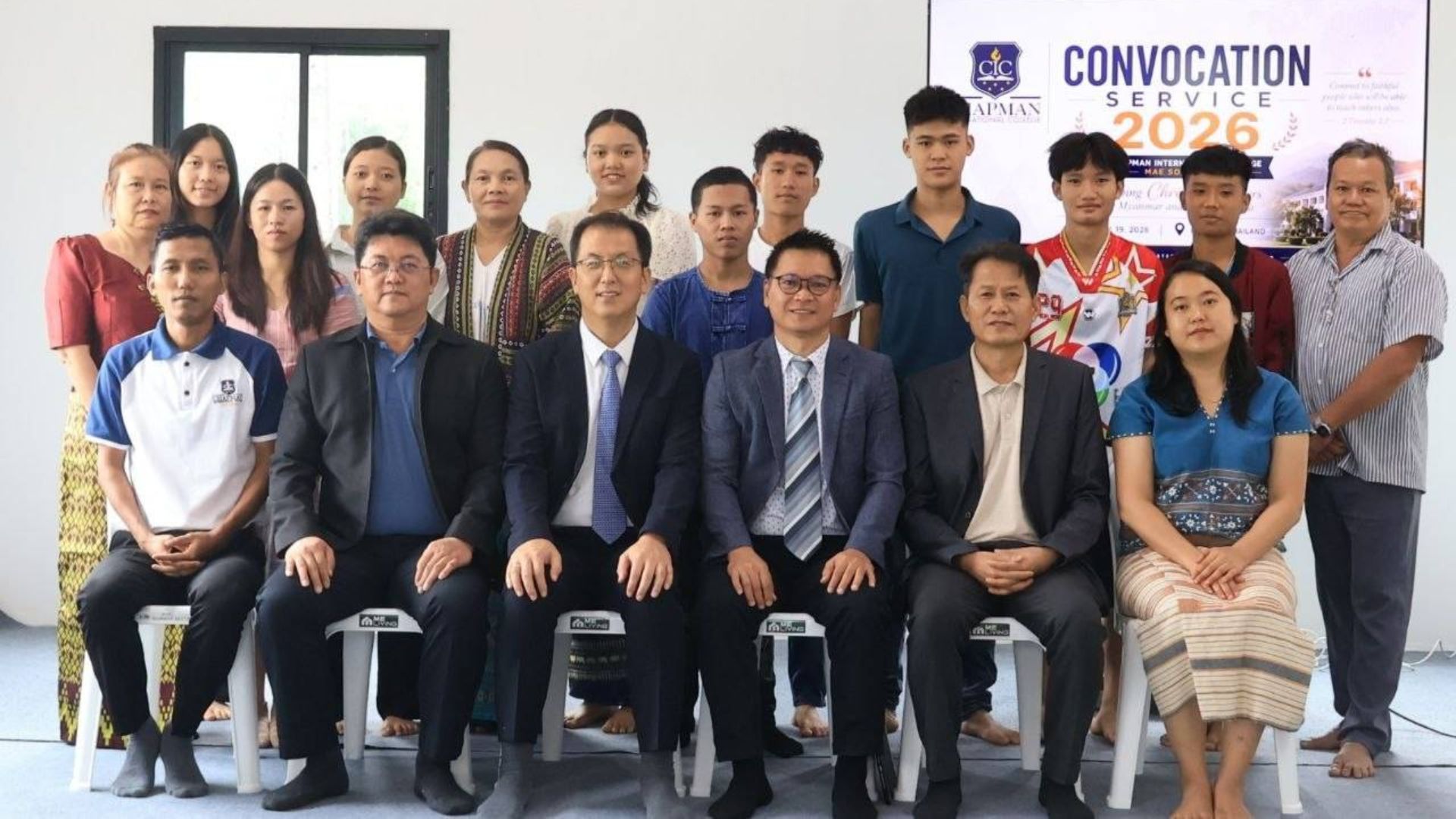
MAE SOT, THAILAND — In a modest classroom near the Thailand–Myanmar border, Chapman International College (CIC) officially opened its 2026 academic year with a Convocation Service at the Mae Sot Center on 19 May. More than simply marking the start of a new academic term, the gathering became a powerful testimony of God’s continuing work among the Myanmar diaspora and refugee communities across Southeast Asia.
More than twenty students gathered for the opening service, representing communities from Mae Sot, Umphang, and the nearby Mae La refugee camp — one of the largest camps for Myanmar refugees along the border. Many students come from migrant, displaced, and refugee backgrounds, carrying stories shaped by conflict, hardship, uncertainty, and perseverance. Some crossed borders seeking safety and opportunity, while others continue ministering among communities deeply affected by instability and displacement.
Despite these realities, the students arrived with a strong sense of calling and commitment to serve God and their people. For many, theological education once seemed beyond reach because of financial limitations, language barriers, migration realities, and limited access to ministry training. Through God’s provision and the partnership of the global church family, they are now being equipped for ministry and leadership.
The convocation theme centered on 2 Timothy 2:2: “Commit to faithful people who will be able to teach others also.” Throughout the service, leaders emphasized the importance of developing Christlike leaders who can disciple others and bring the Gospel into communities affected by conflict, migration, poverty, and displacement. The focus extended beyond academic learning to multiplication — preparing faithful disciples who will continue to teach, serve, plant churches, and reach future generations.
Dr. Bill Kwon, Southeast Asia Field Strategy Coordinator, delivered the message and encouraged students to see theological education not merely as academic preparation, but as training for lifelong mission and service.
“God continues calling faithful men and women even in difficult places,” Kwon shared. “Many of these students come from communities that have experienced suffering and uncertainty, yet they are responding to God’s call with faith and courage.”
The service included worship, prayer, student presentations, and a prayer of commitment and dedication led by regional church leaders and faculty members. Participants included Thailand National Education Coordinator Rev. Suvit Amonkolsawat, SEA Field Diaspora Coordinator Rev. Jubilee Thanga, CIC Chancellor Rev. Mark Eugenio, and Thailand District Superintendent Rev. Phanom Wongriya.
The Mae Sot Center has become an increasingly strategic place for ministry training in Southeast Asia. Located near refugee camps and migrant communities, the center provides theological education to students who may otherwise have little or no access to formal ministry preparation. Many are already actively serving in local churches, discipleship groups, compassionate ministries, youth outreach, and evangelistic efforts among Myanmar diaspora communities along the border region.
In this area alone, there are now twelve vibrant churches — small in size, yet powerful in witness and ministry impact. These congregations serve as centers of worship, discipleship, encouragement, and compassionate care for migrants, refugees, and displaced families. Through these local churches, the Gospel continues to reach communities that are often overlooked and underserved. “What war and displacement intended to destroy, God is transforming into a missionary movement,” one leader shared after the service.
That statement captured the spirit of the gathering. Across the Southeast Asia Field, ministries among Myanmar migrants and refugees continue growing through local churches, compassionate outreach, discipleship training, church planting, and leadership development. Even amid political instability and humanitarian challenges, God continues to open doors for ministry and transformation. Theological education remains a vital part of this mission. Through accessible ministry training, local believers are being equipped with biblical understanding, pastoral skills, spiritual formation, and Gospel-centered leadership to faithfully serve their communities and multiply disciples.
“Because of faithful partnership around the world, students who once thought theological education was impossible are now preparing for ministry,” Kwon said. “God is continuing to build His Church in Southeast Asia, and He is raising leaders for such a time as this.”
As the service concluded with worship and a closing prayer, students left with a renewed sense of calling, unity, and commitment to God’s mission. In a region often associated with crisis and displacement, the Convocation Service stood as a visible reminder that God is still calling, equipping, and sending leaders for His Kingdom.
And in places where many see only hardship and brokenness, the Gospel continues to move forward with hope, healing, and transforming grace.